

The Common Thread
Walk into most classrooms and you’ll find stories everywhere.
In the books on the shelves.
In the historical figures studied.
In the examples used to explain ideas.
But there’s a question we don’t always stop to ask:
Whose stories are being told as stories of success, and whose are not?
Because in education, the people we position as ‘heroes’ quietly shape how students see themselves, and what they believe is possible.
What do we mean by ‘heroes and positive stories’?
This isn’t about creating unrealistic role models or ignoring complexity.
It’s about balance, visibility, and intention.
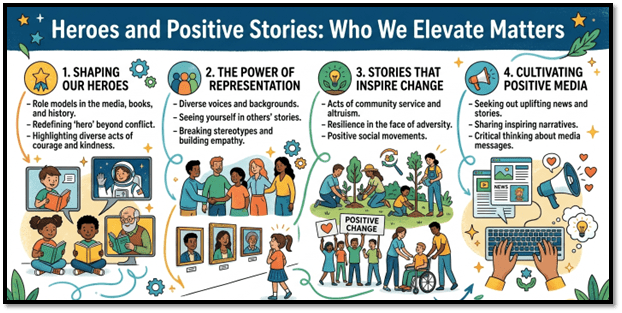
An inclusive curriculum should:
- Highlight achievement, innovation, and leadership across all groups
- Include everyday success stories, not just exceptional figures
- Show people as active agents of change, not just shaped by adversity
- Elevate individuals, and avoid grouping or stereotyping people
An inclusive curriculum understands the multi-dimensional histories and stories of people.
When students repeatedly encounter certain groups only through struggle, it sends a subtle but powerful message about who succeeds, and who doesn’t.
The problem: some stories are repeated, others are restricted
In many curricula, representation exists, but it is unevenly framed.
You might see:
- Individuals from groups primarily taught through historical oppression or injustice
- A narrow set of widely repeated figures
- Success stories that focus heavily on overcoming hardship, rather than achievement in its own right
These stories matter, but when they dominate, they create an incomplete picture.
Students begin to associate:
- Some identities with power, innovation, and leadership
- Others with struggle, resilience, or victimhood
That imbalance shapes perception, often unconsciously.
Why this matters for identity and aspiration
The stories students encounter help answer key internal questions:
- Who succeeds?
- Who leads?
When students see people like themselves consistently represented through positive, varied narratives:
- Their sense of possibility expands
- Aspirations feel more attainable
- Identity becomes a source of strength
At the same time, all students benefit from seeing a wider range of people in positions of influence:
- It challenges assumptions
- Broadens understanding of success
- Builds respect and curiosity
Moving beyond a single narrative
A richer approach:
- Includes scientists, artists, story tellers, leaders, thinkers, and innovators from diverse backgrounds
- Shows multiple pathways to success and reframes what ‘success’ actually means
- Reflects the full complexity of human experience
What this looks like in practice
Building this into the curriculum doesn’t require a complete redesign, it requires thoughtful choices.
1. Audit the stories you elevate
Ask yourself:
- Are certain groups only represented in limited ways?
- Do we show a balance of experiences?
- Do we show local, regional and national examples of success as well as international?
This often reveals patterns that weren’t intentional but are impactful.
2. Broaden the definition of ‘hero’
Include:
- Local and contemporary role models
- Individuals from a range of professions and socioeconomic backgrounds
- Stories of collaboration, not just individual achievement
Not every hero needs to be world-famous to be meaningful. Success has many dimensions!
3. Embed, don’t isolate
Positive representation should be built into everyday teaching, not reserved for specific events, assemblies or months.
This makes inclusion feel normal and consistent, rather than occasional.
4. Be careful with framing
How a story is told matters as much as which story is told.
Consider:
- Are individuals positioned as leaders and creators, or only as responders to difficulty?
- Are we reinforcing or challenging stereotypes?
Small shifts in framing can significantly change impact.
5. Include student perspectives
Students often notice patterns adults miss.
The Global Equality Collective is an excellent place to start and has wonderful tools for gathering voices as well as research on inclusion and belonging!
Common pitfalls to avoid
Even well-intentioned approaches can fall into traps:
- Tokenism: adding limited examples and moving on
- Over-reliance on the same figures: limiting representation to a few familiar names
- Stereotypical narratives: repeating simplified storylines
- Imbalance: showing some groups only through challenge, others only through success
Inclusion is most effective when it is consistent, varied, and authentic.
What you can do tomorrow
If you’re looking to take a first step:
- Review one upcoming lesson or scheme and ask: Who is being positioned as successful here?
- Reflect on whether students are seeing both achievement and diversity
Small, intentional changes accumulate over time.
Final thought
The curriculum does more than teach content, it communicates values.
It tells students:
- Who matters
- Who contributes
- Who succeeds
So it’s worth asking:
Are we showing a world where success looks the same, or one where it truly belongs to everyone?
Because when students see a wide range of people achieving, leading, and thriving,
they don’t just learn about the world,
they begin to see their place within it.
Further reading:
Bennie Kara Kara, B. (2020) A little guide for teachers: diversity in schools. London: Sage Publications Ltd.
Hannah Wilson Wilson, H. (2026) A little guide for teachers: cultivating belonging in schools. London: Sage Publications Ltd.
The Global Equality Collective (Website) The Global Equality Collective (2024) The GEC: making ordinary classrooms extraordinary. Available at: https://www.thegec.education/
GEC Inclusion Index The Global Equality Collective (2024) The GEC inclusion index: issue 3. Available at: https://www.thegec.education/the-gec-inclusion-index-issue-3
The Belonging Effect The Belonging Effect (2024) The belonging effect. Available at: https://www.thebelongingeffect.co.uk/
The Inclusion Solution (Blog Post) Lundy, K. (2021) ‘The stories we tell’, The Inclusion Solution, 21 October. Available at: https://theinclusionsolution.me/point-view-stories-tell/
The Fawcett Society (Blog Post) Sargeant, K. (2020) ‘Teaching Herstory: women in history have remarkable stories to tell. Why are they so often stereotyped or consigned to be victims?’, The Fawcett Society, 5 March. Available at: https://www.fawcettsociety.org.uk/blog/teaching-herstory-women-in-history-have-remarkable-stories-to-tell-why-are-they-so-often-stereotyped-or-consigned-to-be-victims
 The Common Thread
Leave a comment