

The Common Thread
Walk into most classrooms and you’ll see a curriculum that has been carefully planned, structured, and sequenced. In many schools, this planning is grounded in research, designed to support the acquisition and retention of knowledge.
But there’s a deeper question we don’t ask often enough:
Who has access to this knowledge, and who is already at a disadvantage before the lesson even begins?
This is where socioeconomic status must be central to any meaningful approach to Diversity, Equity, Inclusion, and Belonging (DEIB).
Because inclusion isn’t only about identity, it’s also about access.
Educational disadvantage is frequently reduced to a ‘Pupil Premium’ strategy, yet this label misses many students who face similar socioeconomic hardships. Socioeconomic status is foundation to a student’s educational journey, shaping their experiences far beyond what a funding category can capture.
Students from lower-income backgrounds may face barriers that are not immediately obvious in the classroom:
- Limited access to books, technology, or quiet study spaces
- Fewer opportunities for enrichment and the building of cultural capital (trips, tutoring, extracurriculars, experiences that widen understanding beyond the lived day to day)
- Reduced exposure to academic language and vocabulary
- Less familiarity with the hidden expectations of education systems
These factors influence not just attainment, but confidence, participation, social inclusion and belonging.
If DEIB is about removing barriers, socioeconomic inequality must be part of the conversation.
Word poverty and why it matters
One of the most significant impacts of socioeconomic disadvantage is word poverty, the gap in vocabulary exposure and language development that emerges early in life.
Research consistently shows that children from lower-income households are exposed to fewer words and a narrower range of vocabulary before starting school. This gap doesn’t just affect literacy, it affects access to the entire curriculum.
Why this matters:
- Vocabulary is foundational to comprehension and inference across all subjects
- Students may struggle to access exam questions, as well as content
- Classroom discussion can feel exclusionary if language feels unfamiliar
- Confidence in speaking and writing may be significantly reduced
This is not about ability; it’s about exposure and access.
Addressing word poverty is therefore not an intervention at the margins; it is central to equity.
Capital, aspiration, and belonging
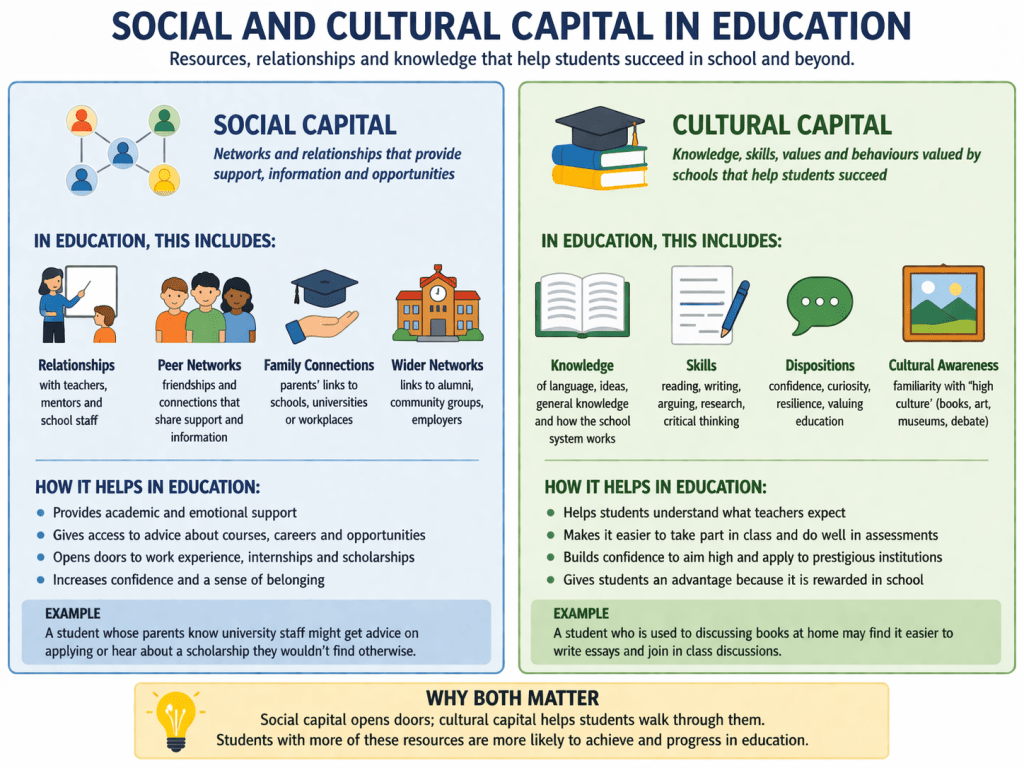
Socioeconomic disadvantage also affects something less tangible but equally important: Social capital and in particular, ‘Bridging Social Capital’[i].
Social capital refers to ‘social networks and social support, trust, reciprocity and community and civic engagement’ (Morrow, 1999:744). It includes:
- Having role models in professional fields
- Feeling comfortable in academic or formal environments
- Having a network from whom you can learn and depend on for mutual (often economic) benefit
Students who lack this capital may not see certain futures as accessible, or even possible.
This has a direct impact on aspiration.
When students don’t see people like them in aspirational roles, or don’t feel they belong in particular spaces, their ambitions can narrow. Not because of a lack of potential, but because of a lack of exposure and affirmation.
‘Research suggests that the social capital of middle class families is much more advantageous than those of the working class and is more beneficial in education’. (Fuller. C, 2014)
Cultural capital[ii] refers to the non financial assets that people have to help them to succeed. This is particularly important in education.
Bourdieu (1964) argued that schools don’t just measure intelligence, they reward the cultural capital that aligns with middle and upper-class norms.
‘Take the 2023 SATs reading paper, it features a camping trip in the highlands and sheep rustling. The assumption here is that all learners have been camping and therefore have a schema for this type of experience. The term ‘Sheep Rustling’ goes much deeper than the simple decoding of the words and will hugely disadvantage those for whom rural life is unfamiliar.’ (Wilby. A, 2024)
Belonging is shaped not just by representation, but by perceived access.
Beyond representation: access and inclusion
An inclusive curriculum must go beyond mirrors and windows. It must also consider doors, who is able to walk through opportunities, and who is left outside.
This means asking deeper questions:
- Are all students equally able to access the curriculum content?
- Do tasks assume prior knowledge or experiences that not all students have?
- Are we explicitly teaching the academic language students need to succeed?
- Are enrichment opportunities genuinely accessible to all?
Inclusion is not just about what is taught, it is about how it is experienced.
What this looks like in practice
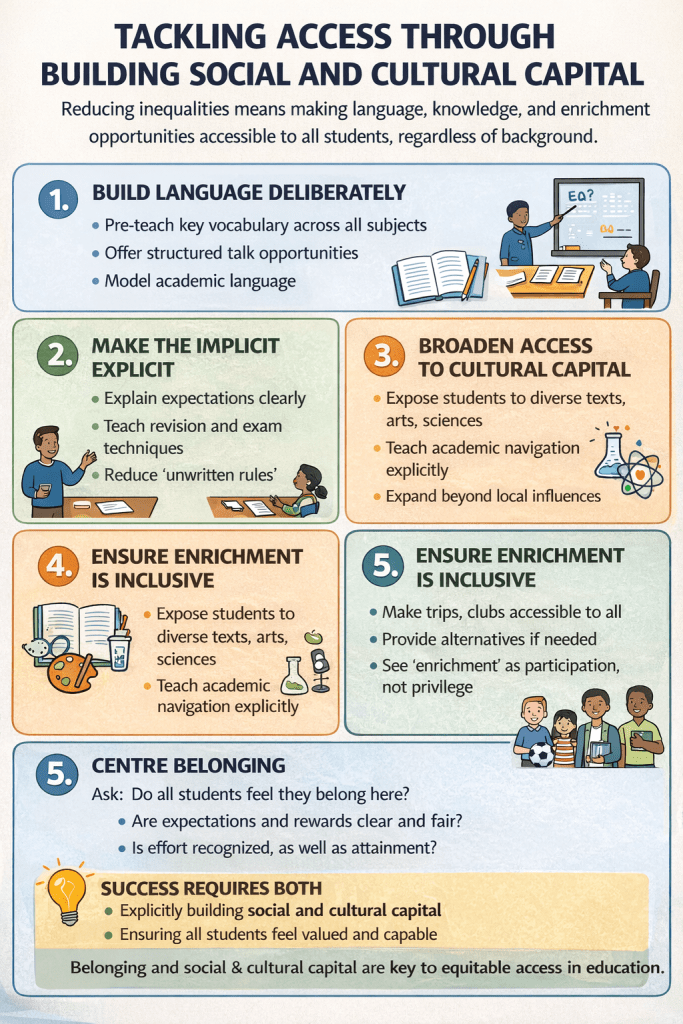
Addressing socioeconomic inequality within DEIB doesn’t require a complete overhaul. It requires intentional, consistent shifts in practice.
1. Build language deliberately
- Pre-teach key vocabulary across all subjects
- Create regular opportunities for structured talk
- Model academic language explicitly
- Recognise that vocabulary development is everyone’s responsibility
2. Make the implicit explicit
- Explain expectations that may otherwise be assumed
- Break down processes like revision, research, and exam technique
- Avoid relying on ‘unwritten rules’ of success, such as speaking confidently, making eye contact, challenging respectfully, discussing careers and money, feeling ‘at home’ in educational settings, organising study
What is obvious to some students is invisible to others.
3. Broaden access to cultural capital
Drawing on Wilby (2024), education is not just about knowledge, but about access to knowledge systems and cultural capital.
This includes:
- Exposure to a wide range of texts, experiences, and ideas
- Opportunities to engage with art, literature, science, and debate
- Explicit teaching of how to navigate academic and professional spaces
The goal is not (and never should be) to replace students’ existing identities, but to expand their access.
4. Rethink enrichment
- Ensure trips, clubs, and activities are financially accessible
- Provide in-school alternatives where needed
- Avoid positioning enrichment as optional extras for a few
Equity means that participation is not determined by income.
5. Centre belonging
Ask:
- Do all students feel this space is ‘for them’?
- Are we reinforcing or challenging assumptions about who succeeds?
- Are we recognising effort and progress as well as attainment?
- Are we making the implicit, explicit?
Belonging is a prerequisite for engagement.
Common pitfalls to avoid
Even with strong intentions, schools can fall into familiar traps:
- Deficit thinking: viewing disadvantaged students through what they lack rather than what they bring
- Assumption of sameness: expecting all students to have similar starting points (or similar aspirations)
- One-size-fits-all approaches: failing to adapt teaching to diverse needs
- Short-term interventions: addressing symptoms rather than systemic barriers
What you can do tomorrow
If you’re not sure where to begin, start small and purposeful:
- Review a lesson and identify potential barriers related to language or prior knowledge
- Introduce explicit vocabulary instruction in your next lesson
- Ask students how confident they feel accessing different aspects of learning
- Audit enrichment opportunities for accessibility
Small, consistent actions build meaningful change over time.
Final thought
An inclusive approach to DEIB must ask not only:
‘Who is represented?’
but also:
‘Who has access, and who feels they belong?’
Socioeconomic disadvantage shapes both.
When schools begin to address this fully, they move closer to a system where every student is not only present, but empowered.
Because true inclusion is not just about being seen.
It’s about being able to participate, succeed, and imagine a future that feels within reach.
Further Reading
Bourdieu, P. (1986) ‘The forms of capital’, in Richardson, J.G. (ed.) Handbook of theory and research for the sociology of education. New York: Greenwood Press, pp. 241–258.
Fuller, C. (2014) ‘Social capital and the role of trust in aspirations for higher education’, Educational Review, 66(2), pp. 131–147. doi:10.1080/00131911.2013.768956.
Granovetter, M.S. (1973) ‘The strength of weak ties’, American Journal of Sociology, 78(6), pp. 1360–1380. doi:10.1086/225469.
Hart, B. and Risley, T.R. (1995) Meaningful differences in the everyday experience of young American children. Baltimore: Paul H. Brookes Publishing.
Robbins, D. (2005) ‘The origins, early development and status of Bourdieu’s concept of “cultural capital”’, The British Journal of Sociology, 56(1), pp. 13–30.
Wilby, A. (2024) Privilege, knowledge, and access: navigating education through cultural capital. Global Equality Collective Blog. https://www.thegec.education/blog/privilege-knowledge-and-access-navigating-education-through-cultural-capital
- [i] The Strength of Weak Ties Mark S. Granovetter The American Journal of Sociology, Vol. 78, No. 6. (May, 1973), pp. 1360-1380.
- [ii] Bourdieu, P. (1986) ‘The forms of capital’, in Richardson, J.G. (ed.) Handbook of theory and research for the sociology of education. New York: Greenwood Press, pp. 241–258.
 The Common Thread
Leave a comment