

The Common Thread
Walk into most classrooms and you will see a curriculum that has been carefully planned, structured, and sequenced. In the vast majority of UK secondary schools, this planning is firmly grounded in cognitive science, designed to support the acquisition and long-term retention of knowledge.
But there is a deeper question that we, as educators, do not ask nearly often enough:
Who gets to see themselves in that knowledge, and who is left looking from the outside in?
For too long, Key Stage 3 has occupied an uncomfortable, transitional grey area in secondary education—treated as a holding space between primary school and GCSE preparation. Thinkers like Mary Myatt have fiercely challenged this, arguing that Years 7 to 9 must instead be the ‘intellectual powerhouse’ of the school rather than ‘the wasted years’.
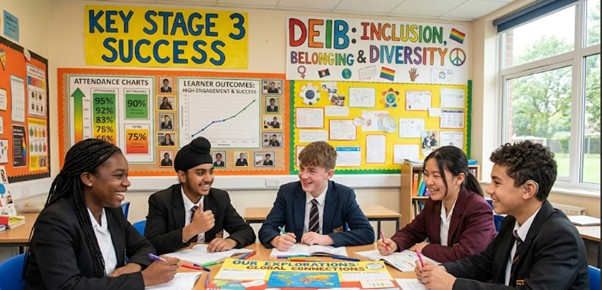
When pitched correctly, an ambitious KS3 curriculum does not alienate learners; instead, it serves as the ultimate engine for Diversity, Equity, Inclusion, and Belonging (DEIB), attendance improvement, and academic excellence.
The Core Concept: Mirrors, Windows, and Belonging
To build a truly inclusive, high-achieving KS3 environment, we must embrace the classic concept of curriculum as ‘Mirrors and Windows’, originally coined by Professor Rudine Sims Bishop (1990).
- Mirrors: A curriculum must allow students to see their own identities, cultures, experiences, and heritages validated and reflected.
- Windows: A curriculum must offer students a clear view into lives, cultures, and perspectives entirely different from their own.
When a curriculum is structurally lacking, the consequences manifest directly in school data. If students only experience windows, they can feel invisible, unmapped, and alienated from the academic narrative, causing engagement, and consequently, attendance, to plummet. Conversely, if they only experience mirrors, they are denied the global literacy required to build empathy and cultural understanding.
Importantly, ambition and inclusion are not opposing forces. Lowering academic expectations in the name of ‘accessibility’ inadvertently harms disadvantaged and marginalised learners by denying them access to high-status, ‘powerful knowledge’ (a concept pioneered by sociologist Michael Young).
A genuinely inclusive curriculum says: Every learner is entitled to complexity, beauty, sophisticated vocabulary, and authentic scholarship.
Curriculum design
Architectural Clarity: The ‘Know, Understand, Do’ Framework
To operationalise an ambitious, inclusive curriculum, schools must abandon static, tokenistic schemes of learning.
By structuring curriculum architecture into distinct Know, Understand, and Do phases, we ensure that deep knowledge, diverse representation, and student agency form a coherent whole. This contemporary framework powerfully mirrors Martin Robinson’s (2013) concept of a Trivium for the 21st Century, which revives the classical sequence of Grammar (knowing the facts), Dialectic (understanding through critical questioning), and Rhetoric (doing through public expression and oracy).
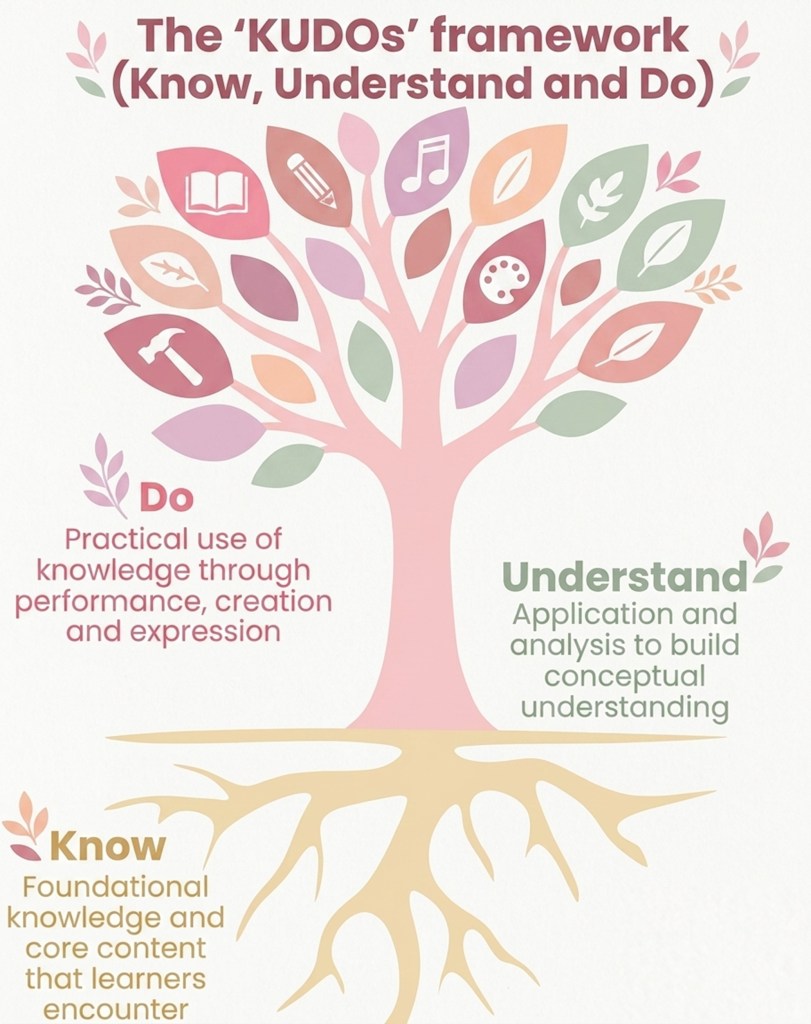
1. The ‘Know’ Phase: Building Intellectual Capital
The bedrock of an ambitious curriculum is explicit, powerful knowledge that moves beyond superficial, ‘add-on’ representation.
- Key Knowledge and Living Sequences: Rather than isolated topics pinned to specific GCSE specs, core concepts should be mapped vertically from KS2 to KS5. This content must be dynamic and updated annually to reflect changing global contexts, evolving histories, and newly amplified academic voices.
- Tier 3 Vocabulary and Etymology: Academic language is intellectual equity. Mary Myatt’s work consistently emphasises that vocabulary breadth is one of the strongest predictors of academic success. Rather than displaying arbitrary word lists, explicitly teach the morphology and etymology of Tier 3 terms (e.g., breaking down the Latin root dict, ‘to say’ to unlock dictator, contradiction, and prediction). This explicitly democratises language, giving lower prior attaining or EAL students the structural tools to decode complex academic literature independently.
2. The ‘Understand’ Phase: Embracing Complexity
True understanding occurs when knowledge is contextualised through human narratives and wrestled with through high-level inquiry.
- Story as the Architecture of Memory: The human brain privileges narrative over disjointed facts, a principle championed by cognitive scientist Daniel Willingham and frequently highlighted by Myatt. Teach the rich stories behind knowledge, the human conflicts behind historical changes, the cultural intersections of mathematical discoveries, or the diverse narratives of scientific breakthrough.
- Driven by ‘Big Questions’: Replace passive, topic-based learning with unit-defining philosophical inquiry. Questions like ‘Who gets remembered in history?’, ‘Is progress always a good thing?’, or ‘Can science ever be completely objective?’ demand that young people learn to sit with complexity and ambiguity.
- High Pitch, High Scaffold: True equity means refusing to dilute the curriculum. Every student encounters the same rich, high-status text. Inclusion is achieved by layering robust scaffolds—such as guided annotations, visual dual coding, and pre-taught vocabulary, keeping the destination identical for all.
3. The ‘Do’ Phase: Agency and Scholarly Expression
Knowledge and understanding must culminate in students actively applying and articulating their learning.
- Oracy as an Engine of Inclusion: If vocabulary is power, structured oracy is the vehicle for intellectual agency. Ambitious KS3 classrooms move past worksheet compliance and instead hear students engaging in formal debates, expert panels, seminar discussions, and collaborative philosophical inquiries.
- Exhibitions of Excellence: Celebrate outcomes by taking work public. When students present their academic products through gallery exhibitions, community lectures, or publications, their self-perception shifts fundamentally. They cease to be passive task-completers and become active contributors to knowledge.
Authentic DEIB: Moving Beyond ‘Add and Stir’
A common pitfall in curriculum diversification is the ‘add and stir’ method: dropping in a one-off assembly during a particular heritage month, purchasing a few diverse library books, or attaching an occasional, isolated ‘meanwhile, elsewhere’ slide to a history lesson. Students easily detect this performative tokenism, which can inadvertently reinforce the feeling of being outside the main institutional narrative.
As highlighted by Bhorkar, Campbell, and Claro (2025) in the Chartered College of Teaching’s Impact journal, schools must look ‘beyond the tick-box’. Inclusion and high pitch must be integrated natively across disciplines:
- English and Literature: Diversify authors and perspectives organically across the entire academic year, ensuring students encounter marginalised groups not merely through narratives of struggle or oppression, but through multidimensional stories of leadership, joy, creativity, and everyday nuance.
- Science and Maths: Highlight contributions from a globally diverse array of scientists, mathematicians, and philosophers, actively challenging historically narrow perceptions of who belongs in STEM fields (aligning with recommendations from Teach First’s STEMinism insights). Use real-world problems that reflect varied geographical and economic contexts.
- History and Geography: Embed multiple perspectives natively within a singular historical enquiry rather than tacking an alternative view onto the very last lesson. Avoid deficit narratives in geography by exploring global diversity, urbanisation, and environmental shifts with academic depth and structural balance, as advocated by the Geographical Association.
The Blueprint: Actions for Tomorrow and the Future
Transitioning into an ‘intellectual powerhouse’ requires immediate tactical shifts paired with long-term strategic evolution.
What You Can Do Tomorrow (Quick Wins)
- Audit the Pitch of an Upcoming Lesson: Review your slides for next week. If a text has been overly simplified or replaced by a basic fill-in-the-blank worksheet, substitute it with an authentic, high-status extract or primary source. Plan exactly how you will verbally scaffold it for your lower-reading-age students and don’t limit the reading by focusing on smaller extracts, encourage reading where possible.
- Unpack One Root Word Explicitly: Identify a core Tier 3 word for tomorrow’s lesson. Don’t just define it; map its morphology on the board. Show its prefix, root, or suffix, and prompt students to connect it to other words they already know.
- Reframe a Title as an Inquiry Question: Shift a dry topic heading into a thought-provoking prompt. Use it to run a brief ‘Cold Call’ session using structured sentence stems (e.g., ‘While I appreciate that perspective, the evidence suggests…’) to explicitly support scholarly dialogue.
- Check the Framework of Representation: Look at your current unit. If a demographic group is only represented through a lens of trauma or subjugation, intentionally introduce a parallel narrative highlighting their innovation, agency, or cultural leadership.
What You Can Do in the Future (Systemic, Strategic Shifts)
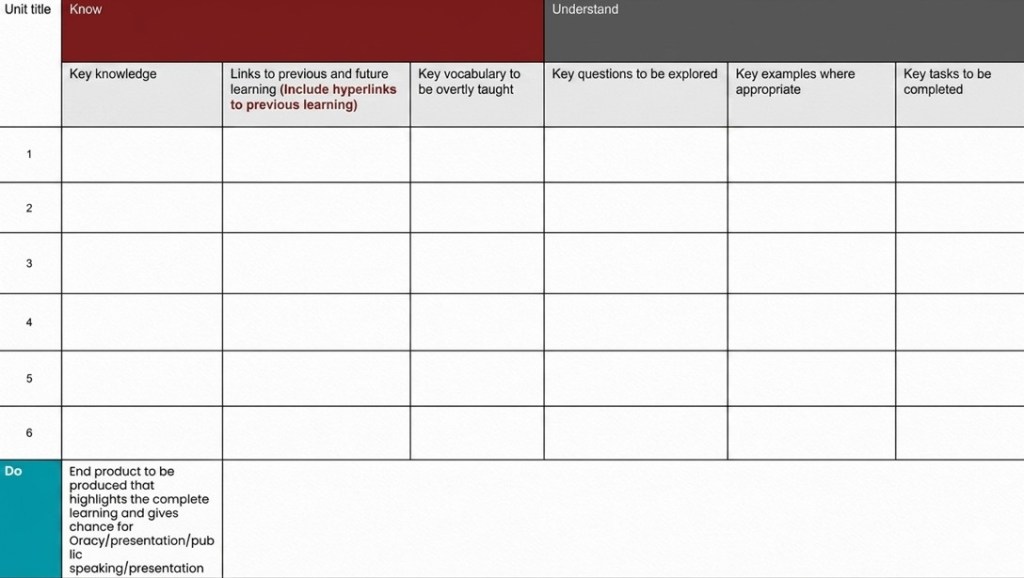
- Overhaul Department Planning Documentation: Transition your schemes of work into the Know, Understand, Do architecture. Dedicate directed CPD time for departments to explicitly map Key Knowledge, Vertical Links, Tier 3 Vocabulary, Big Questions, and Oracy-driven tasks.
- Systematise a Living Curriculum Review Cycle: Move away from static, laminated curriculum binders. Build an annual review process where subject specialists intentionally refresh case studies, literature selections, and historical contexts, ensuring the curriculum dynamically evolves alongside contemporary scholarship and global realities.
- Launch an ‘Exhibition of Excellence’ Framework: Move past hidden terminal assessments in KS3. Build a formal calendar event where families, peers, and external guests are invited to an open exhibition. Students act as curators, standing by their final products and verbally articulating their academic journey.
- Triangulate Student Voice with Analytical Data: Actively survey your students by asking: ‘Do you see yourself in what we learn?’ Partner with platforms like the Global Equality Collective (GEC) to gather kaleidoscopic student and staff voice data. Use these analytics to pinpoint concrete curricular gaps that standard quality assurance checks often overlook.
- Align Attendance Strategies with Curriculum Authenticity: Train pastoral, inclusion, and attendance teams to recognise curriculum alienation as a root cause of persistent absence. When a student begins to disengage, evaluate whether they feel visible, academically respected, and structurally capable of success within their daily lessons.
A Summary of the Paradigm Shift
| From a Legacy KS3 Model | To an Ambitious, Inclusive KS3 Powerhouse |
| Treating KS3 as an unvalued ‘waiting room’ or transition space for GCSE metrics. | Treating KS3 as the moral, intellectual, and cultural centre of the institution. |
| Oversimplifying complex texts to create superficial, low-level accessibility. | Maintaining an elite academic pitch while engineering robust, intelligent scaffolding. |
| Tokenistic, performative DEIB confined to isolated assemblies or heritage months. | Organic DEIB built directly and consistently into the core fabric of daily lessons. |
| Measuring student output strictly through traditional, hidden exam papers. | Cultivating student agency through structured oracy and public Exhibitions of Excellence. |
Final Thoughts
An inclusive curriculum is not a box-ticking exercise, a superficial compliance measure, or a dilution of standards. It is an act of deep educational equity. It answers a foundational question: ‘Does every student feel seen here, and are they being supported to clearly see others?’
When a school’s answer to that question becomes a consistent, resounding ‘yes,’ the environment changes completely. You are no longer merely delivering information to clear an inspection threshold; you are building deep belonging, inspiring improved attendance, and unlocking authentic academic excellence.
That is not wasted time. That is the very definition of a school powerhouse.
References and Further Reading
- Bhorkar, S., Campbell, R. and Claro, J. (2025) ‘Beyond the tick-box: diversity in the curriculum’, Impact: Journal of the Chartered College of Teaching. Available at: Chartered College of Teaching
- Bishop, R. S. (1990) ‘Mirrors, windows, and sliding glass doors’, Perspectives: Choosing and Using Books for the Classroom, 6(3). Available at: Sims Bishop Essay PDF
- Geographical Association (n.d.) Cultural diversity in geography education. Available at: Geographical Association
- Mary Myatt Learning / Myatt and Co (n.d.) Key Stage 3: The Ambitious Years Available at: Myatt and Co
- Pearson (2023) Pearson School Report: Diversity and Inclusion.
- Teach First (2020) STEMinism: How to encourage more girls to study STEM subjects. Available at: Teach First Report
- The Global Equality Collective (n.d.) GEC KnowHow Platform. Available at: The GEC
- Robinson, M. (2013) Trivium 21c: Preparing young people for the future with a lesson from the past. Cardiff: Crown House Publishing.
- Sherrington, T. (2014, January 17). Trivium 21st C: Could this be the answer? Teacherhead. https://teacherhead.com/2014/01/17/trivium-21st-c-could-this-be-the-answer/
- Willingham, D. T. (2004). The privileged status of story. American Educator, 28(2), 22–29.
- Willingham, D. T. (2009). Why don’t students like school?: A cognitive scientist answers questions about how the mind works and what it means for the classroom (2nd ed.). Jossey-Bass.
- Willingham, D. T. (2013, June 3). Storify: Make science tell a story. Science & Education Blog. http://www.danielwillingham.com/daniel-willingham-science-and-education-blog/storify-make-science-tell-a-story


Leave a Reply